

What happens when the digital nomad lifestyle doesn’t unfold on tropical beaches anymore, but at the northernmost edge of Europe, inside an off-grid ice cabin?
For a long time, the digital nomad lifestyle was defined by a very specific visual era: co-working in Bali, laptops on the beach, sun-drenched flexibility. Today, however, a more radical direction is emerging in the Scandinavian tech scene: infrastructure - independent work.
It’s no longer about where you work.
It’s about what you need in order to work at all.
Listen while reading:
Silent Code ❄️
The article, translated into music.
Infrastructure as the new level of freedom
While urban life is built on dependence on public utilities, northern off-grid pioneers such as Parkudden Energi founder Hans-Olof Nilsson or the designers behind Majamaja self-sustaining cabins have proven that even on the edge of civilization, a high-tech working environment can be maintained.
The modern “Arctic stack” consists of:
Energy: Hybrid solar and wind systems capable of producing up to 30,000 kWh annually, fully independent from the Scandinavian grid.
Connectivity: The breakthrough came with Starlink satellite internet, offering stable 100–250 Mbps speeds even in the northernmost regions of Norway, enabling uninterrupted Zoom calls and remote server access.
Environment: Modular Arctic-designed container homes, insulated for conditions down to -40°C (NS 3515 standard). (example)
Environment as productivity infrastructure
Classic productivity models are built around digital tools, but more and more research shows that physical environment plays an equally important role.
Urban productivity is based on interruptions. Arctic productivity is based on continuity. Initiatives such as Arctic Digital Nomads build on the idea that proximity to nature is not just inspiration — it is a cognitive trigger for deep work.
No noise: cognitive fragmentation disappears.
No FOMO: physical isolation removes attention-draining social stimuli.
Asynchronicity: extreme environments require structured, rhythm-based communication instead of constant online presence.
The new meaning of “nomad”
The earlier model was about location independence.
The new model is about infrastructure independence.
What matters is not where you are, but:
How do you generate energy?
How do you maintain your connection to the outside world?
How do you structure time according to natural rhythms?
Off-grid experiments in the North including tech communities in Lapland or Svalbard show that the biggest luxury of the future is not mobility, but uninterrupted attention.
Here, silence is not a spiritual concept. It is technology. As off-grid developers say: debugging under the Northern Lights is not magic, it is the highest form of undisturbed cognitive performance.
Silence as technology
One of the most interesting paradoxes of the future of work is this:
the more advanced technology becomes,
the more valuable silence becomes.
Not in a spiritual sense, but as uninterrupted cognitive operation.
Themes
◉ Infrastructure Independence
◉ Off-Grid Living
◉ Remote Work
◉ Deep Work
◉ Cognitive Performance
◉ Arctic Productivity
◉ Attention as a Resource
Less Noise. More Signal.
FROM ARTICLE TO SOUND
Signal: Silent Code
This soundtrack was created from themes explored in this article.
◉ Infrastructure Independence
◉ Deep Work
◉ Environmental Design
◉ Cognitive Performance
About SIGNAL
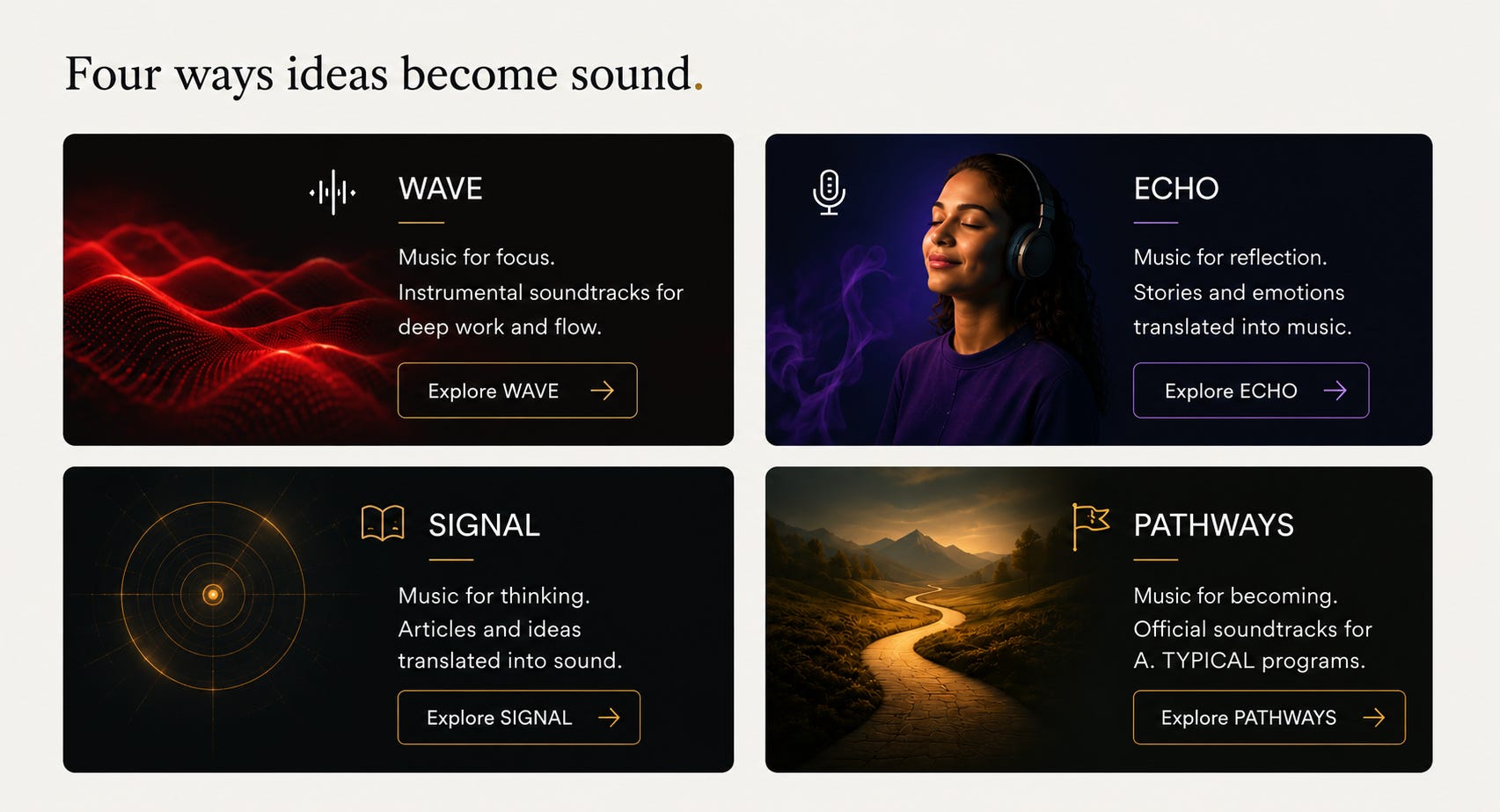
SIGNAL transforms ideas into sound.
Each track is created from an article, essay or written reflection exploring the future of work, technology and human potential.
Articles translated into music.
Continue Exploring
THE ECOSYSTEM